Physaraceae
| Physaraceae | |||||||||||
|---|---|---|---|---|---|---|---|---|---|---|---|
| |||||||||||
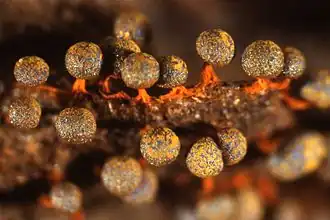
| Physarum psittacinum | |||||||||||
| Taxonomische indeling | |||||||||||
| |||||||||||
| Familie | |||||||||||
| Physaraceae Chevall. (1826) | |||||||||||
Afbeeldingen op  Wikimedia Commons Wikimedia Commons
| |||||||||||
| |||||||||||

Physaraceae zijn een familie van plasmodiale slijmzwammen (Myxogastria). De wetenschappelijke naam van de familie werd in 1826 gepubliceerd door François Fulgis Chevallier.
De familie omvat de volgende geslachten (stand 2019):[1]
- Badhamia Berk. (1853)
- Craterium Trentep. (1797)
- Fuligo Haller (1768)
- Kelleromyxa Eliasson (1991)
- Leocarpus Link (1809)
- Physarella Peck. (1882)
- Physarina Höhn. (1909)
- Physarum Pers. (1794)
- Badhamia Berk. (1853)
Willkommlangea behoort mogelijk ook tot deze familie.
Voorheen in deze familie
- Didymium, nu in eigen familie Didymiaceae
- Protophysarum, volgens Index Fungorum nog Incertae sedis, maar mogelijk in de familie Didymiaceae te plaatsen
Foto's
- Verschillende Physaraceae
-
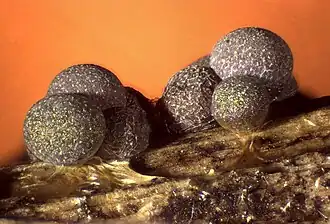 Badhamia foliicola, graskalknetje
 -
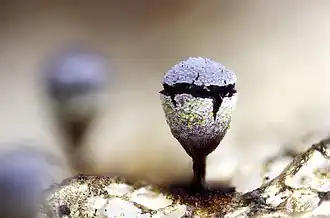 Craterium leucocephalum, conisch kalkbekertje
 -
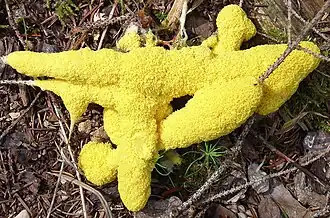 Fuligo septica, heksenboter
 -
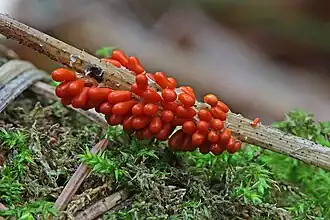 Leocarpus fragilis, glanzend druivenpitje
 -
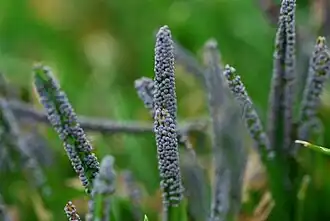 Physarum cinereum, grijs kalkkopje
 -
_Kuntze_575110.jpg) Willkommlangea reticulata, geperforeerd graatje
Willkommlangea reticulata, geperforeerd graatje
Bronnen, noten en/of referenties
- ↑ Leontyev, Dmitry V.; Schnittler, Martin; Stephenson, Steven L.; Novozhilov, Yuri K. & Shchepin, Oleg N. (2019). Towards a phylogenetic classification of the Myxomycetes. Phytotaxa 399 (3): 209. ISSN: 1179-3163. DOI: 10.11646/phytotaxa.399.3.5.