Vampyriscus
| Vampyriscus | |||||||||||||
|---|---|---|---|---|---|---|---|---|---|---|---|---|---|
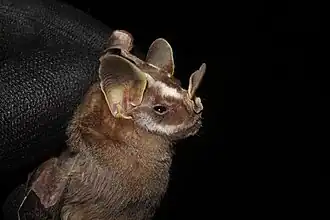
| |||||||||||||
| Vampyriscus bidens | |||||||||||||
| Taxonomische indeling | |||||||||||||
| |||||||||||||
| Geslacht | |||||||||||||
| Vampyriscus Thomas, 1900 | |||||||||||||
Afbeeldingen op  Wikimedia Commons Wikimedia Commons
| |||||||||||||
Vampyriscus op  Wikispecies Wikispecies
| |||||||||||||
| |||||||||||||

Vampyriscus is een geslacht van zoogdieren uit de familie van de bladneusvleermuizen van de Nieuwe Wereld (Phyllostomidae). De wetenschappelijke naam van het geslacht werd in 1900 gepubliceerd door Oldfield Thomas.[1][2]
Soorten
Er worden 3 soorten in dit geslacht geplaatst:[3]
- Vampyriscus bidens O. Thomas, 1891
- Vampyriscus brocki Handley, 1960
- Vampyriscus nymphaeus Baker & Genoways, 1976
Bronnen, noten en/of referenties
- ↑ Hoofer, S. R., & Baker, R. J. (2006). Molecular systematics of Vampyressine bats (Phyllostomidae: Stenodermatinae) with comparison of direct and indirect surveys of mitochondrial DNA variation. Molecular Phylogenetics and Evolution, 39(2), 424-438.
- ↑ Simmons, N.B. (2005). "Order Chiroptera". In Wilson, D.E.; Reeder, D.M (eds.) Mammal Species of the World: A Taxonomic and Geographic Reference (3rd ed.). Johns Hopkins University Press. pp. 425-426. ISBN 978-0-8018-8221-0.
- ↑ Mammal Diversity Database (2024). Mammal Diversity Database (Version 1.13) [Data set]. Zenodo. DOI: 10.5281/zenodo.10595931. Gearchiveerd van origineel op 25-12-2022. Geraadpleegd op 03-02-2025.