Groeidifferentiatie factor
Groeidifferentiatie factoren (GDF's) zijn een groep vergelijkbare signaaleiwitten die door dierlijke cellen worden vrijgegeven om naburige cellen te beïnvloeden, de zogenaamde cytokines. De GDF's maken deel uit van de TGF-β-signaleringsroute, een van de fundamentele signaalsystemen voor communicatie tussen cellen en die voornamelijk functies hebben in de ontwikkeling.[1]
Typen
Van deze subfamilie zijn de volgende groeidifferentiatie factoren beschreven:
- GDF1 wordt voornamelijk tot expressie gebracht in het zenuwstelsel en functioneert in links-rechts patroonvorming en mesoderminductie tijdens de embryonale ontwikkeling.[2]
- GDF2 (ook bekend als BMP9) induceert en onderhoudt de respons die embryonale basale voorhersenen cholinerge zenuwcellen (BFCN) hebben op de neurotransmitter acetylcholine, en reguleert het ijzermetabolisme door de niveaus van hepcidine te verhogen.[3][4]
- GDF3 staat ook bekend als "Vg-related gene 2" (Vgr-2). Expressie van GDF3 vindt plaats in ossificerend bot tijdens de embryonale ontwikkeling en in de thymus, milt, beenmerghersenen en vetweefsel van volwassenen. Het heeft een dubbele functie; het remt en induceert zowel vroege stadia van ontwikkeling in embryo's.[5][6][7]
- GDF5 wordt tot expressie gebracht in het zich ontwikkelende centraal zenuwstelsel, met rollen in de ontwikkeling van gewrichten en het skelet, en het vergroten van de overleving van zenuwcellen die reageren op de neurotransmitter dopamine.[8][9][10]
- GDF6 interageert met botmorfogenetisch proteïnen om ectodermweefselvorming te reguleren en controleert de ontwikkeling van de ogen.[11][12][13]
- GDF8 staat nu officieel bekend als myostatine en controleert de groei van spierweefsel.[14]
- GDF9, net als GDF3, mist één cysteïne in vergelijking met andere leden van de TGF-β-superfamilie. De genexpressie is beperkt tot de eierstokken en het speelt een rol bij de ovulatie.[15][16]
- GDF10 is nauw verwant aan BMP3 en speelt een rol bij de vorming van het hoofd en, naar men aanneemt, bij de morfogenese van het skelet.[17][18] Het staat ook bekend als BMP-3b.
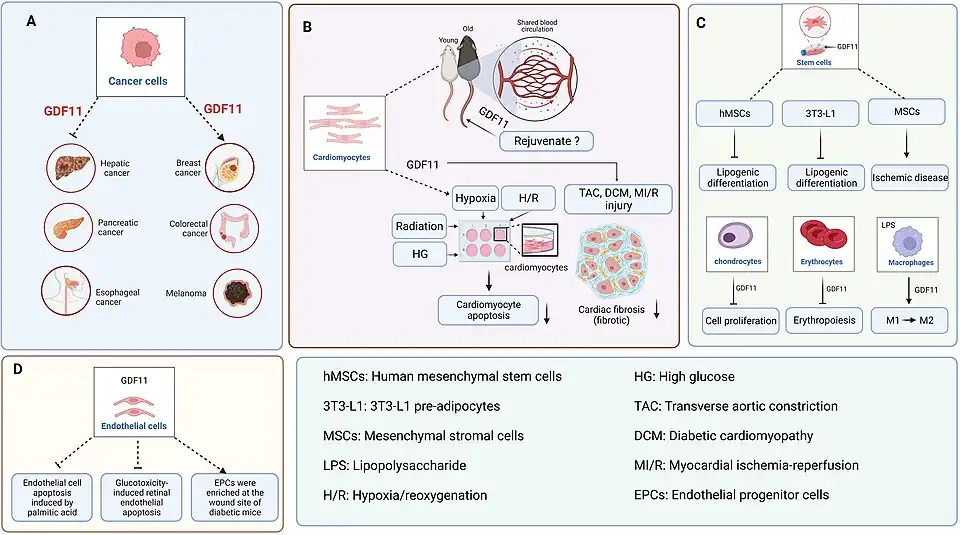
- GDF11 controleert het anterieure-posterieure patroon door de expressie van Hoxgenen te reguleren,[19] en reguleert het aantal olfactorische receptorzenuwcellen dat voorkomt in het olfactorische epitheel van de neus,[20]en het aantal zenuwknoopcellen dat zich ontwikkelt in het netvlies.[21]
- GDF15 (ook bekend als TGF-PL, MIC-1, PDF, PLAB en PTGFB) speelt een rol bij het reguleren van ontstekingen en apoptose tijdens weefselbeschadiging en bepaalde ziekteprocessen.[22][23][24] Ook neemt de expressie toe door metformine.[25]
Bronnen, noten en/of referenties
Dit artikel of een eerdere versie ervan is een (gedeeltelijke) vertaling van het artikel Growth differentiation factor op de Engelstalige Wikipedia, dat onder de licentie Creative Commons Naamsvermelding/Gelijk delen valt. Zie de bewerkingsgeschiedenis aldaar.
- ↑ Herpin A, Lelong C, Favrel P (2004). Transforming growth factor-beta-related proteins: an ancestral and widespread superfamily of cytokines in metazoans. Dev Comp Immunol 28 (5): 461–85. PMID 15062644. DOI: 10.1016/j.dci.2003.09.007.
- ↑ Rankin C, Bunton T, Lawler A, Lee S (2000). Regulation of left-right patterning in mice by growth/differentiation factor-1. Nat Genet 24 (3): 262–5. PMID 10700179. DOI: 10.1038/73472.
- ↑ Lopez-Coviella I, Follettie M, Mellott T, Kovacheva V, Slack B, Diesl V, Berse B, Thies R, Blusztajn J (2005). Bone morphogenetic protein 9 induces the transcriptome of basal forebrain cholinergic neurons. Proc Natl Acad Sci USA 102 (19): 6984–9. PMID 15870197. PMC 1088172. DOI: 10.1073/pnas.0502097102.
- ↑ Truksa J, Peng H, Lee P, Beutler E (2006). Bone morphogenetic proteins 2, 4, and 9 stimulate murine hepcidin 1 expression independently of Hfe, transferrin receptor 2 (Tfr2), and IL-6. Proc Natl Acad Sci USA 103 (27): 10289–93. PMID 16801541. PMC 1502450. DOI: 10.1073/pnas.0603124103.
- ↑ Levine A, Brivanlou A (2006). GDF3 at the crossroads of TGF-beta signaling. Cell Cycle 5 (10): 1069–73. PMID 16721050. DOI: 10.4161/cc.5.10.2771.
- ↑ Levine A, Brivanlou A (2006). GDF3, a BMP inhibitor, regulates cell fate in stem cells and early embryos. Development 133 (2): 209–16. PMID 16339188. DOI: 10.1242/dev.02192.
- ↑ Chen C, Ware S, Sato A, Houston-Hawkins D, Habas R, Matzuk M, Shen M, Brown C (2006). The Vg1-related protein Gdf3 acts in a Nodal signaling pathway in the pre-gastrulation mouse embryo. Development 133 (2): 319–29. PMID 16368929. DOI: 10.1242/dev.02210.
- ↑ O'Keeffe G, Dockery P, Sullivan A (2004). Effects of growth/differentiation factor 5 on the survival and morphology of embryonic rat midbrain dopaminergic neurones in vitro. J Neurocytol 33 (5): 479–88. PMID 15906156. DOI: 10.1007/s11068-004-0511-y.
- ↑ Buxton P, Edwards C, Archer C, Francis-West P (2001). Growth/differentiation factor-5 (GDF-5) and skeletal development. J Bone Joint Surg Am 83-A Suppl 1 (Pt 1): S23–30. PMID 11263662.
- ↑ Francis-West P, Parish J, Lee K, Archer C (1999). BMP/GDF-signalling interactions during synovial joint development. Cell Tissue Res 296 (1): 111–9. PMID 10199971. DOI: 10.1007/s004410051272.
- ↑ Chang C, Hemmati-Brivanlou A (1999). Xenopus GDF6, a new antagonist of noggin and a partner of BMPs. Development 126 (15): 3347–57. PMID 10393114. DOI: 10.1242/dev.126.15.3347.
- ↑ Asai-Coakwell M, French C, Berry K, Ye M, Koss R, Somerville M, Mueller R, van Heyningen V, Waskiewicz A, Lehmann O (2007). GDF6, a novel locus for a spectrum of ocular developmental anomalies. American Journal of Human Genetics 80 (2): 306–15. PMID 17236135. PMC 1785352. DOI: 10.1086/511280.
- ↑ Hanel M, Hensey C (2006). Eye and neural defects associated with loss of GDF6. BMC Dev Biol 6: 43. PMID 17010201. PMC 1609107. DOI: 10.1186/1471-213X-6-43.
- ↑ McPherron AC, Lawler AM, Lee SJ (May 1997). Regulation of skeletal muscle mass in mice by a new TGF-beta superfamily member. Nature 387 (6628): 83–90. PMID 9139826. DOI: 10.1038/387083a0.
- ↑ Juengel J, Bodensteiner K, Heath D, Hudson N, Moeller C, Smith P, Galloway S, Davis G, Sawyer H, McNatty K (2004). Physiology of GDF9 and BMP15 signalling molecules. Anim Reprod Sci 82-83: 447–60. PMID 15271472. DOI: 10.1016/j.anireprosci.2004.04.021.
- ↑ Hreinsson J, Scott J, Rasmussen C, Swahn M, Hsueh A, Hovatta O (2002). Growth differentiation factor-9 promotes the growth, development, and survival of human ovarian follicles in organ culture. J Clin Endocrinol Metab 87 (1): 316–21. PMID 11788667. DOI: 10.1210/jcem.87.1.8185.
- ↑ Hino J, Kangawa K, Matsuo H, Nohno T, Nishimatsu S (2004). Bone morphogenetic protein-3 family members and their biological functions. Front Biosci 9 (1–3): 1520–9. PMID 14977563. DOI: 10.2741/1355.
- ↑ Cunningham N, Jenkins N, Gilbert D, Copeland N, Reddi A, Lee S (1995). Growth/differentiation factor-10: a new member of the transforming growth factor-beta superfamily related to bone morphogenetic protein-3. Growth Factors 12 (2): 99–109. PMID 8679252. DOI: 10.3109/08977199509028956.
- ↑ Andersson O, Reissmann E, Ibáñez C (2006). Growth differentiation factor 11 signals through the transforming growth factor-beta receptor ALK5 to regionalize the anterior-posterior axis. EMBO Reports 7 (8): 831–7. PMID 16845371. PMC 1525155. DOI: 10.1038/sj.embor.7400752.
- ↑ Wu H, Ivkovic S, Murray R, Jaramillo S, Lyons K, Johnson J, Calof A (2003). Autoregulation of neurogenesis by GDF11. Neuron 37 (2): 197–207. PMID 12546816. DOI: 10.1016/S0896-6273(02)01172-8.
- ↑ Kim J, Wu H, Lander A, Lyons K, Matzuk M, Calof A (2005). GDF11 controls the timing of progenitor cell competence in developing retina. Science 308 (5730): 1927–30. PMID 15976303. DOI: 10.1126/science.1110175.
- ↑ Zimmers T, Jin X, Hsiao E, McGrath S, Esquela A, Koniaris L (2005). Growth differentiation factor-15/macrophage inhibitory cytokine-1 induction after kidney and lung injury. Shock 23 (6): 543–8. PMID 15897808.
- ↑ Hsiao E, Koniaris L, Zimmers-Koniaris T, Sebald S, Huynh T, Lee S (2000). Characterization of growth-differentiation factor 15, a transforming growth factor beta superfamily member induced following liver injury. Mol Cell Biol 20 (10): 3742–51. PMID 10779363. PMC 85678. DOI: 10.1128/MCB.20.10.3742-3751.2000.
- ↑ Ago T, Sadoshima J (2006). GDF15, a cardioprotective TGF-beta superfamily protein. Circ Res 98 (3): 294–7. PMID 16484622. DOI: 10.1161/01.RES.0000207919.83894.9d.
- ↑ Wang, D., Day, E.A., Townsend, L.K. et al. GDF15: emerging biology and therapeutic applications for obesity and cardiometabolic disease. Nat Rev Endocrinol 17, 592–607 (2021). https://doi.org/10.1038/s41574-021-00529-7