Dryadaula
| Dryadaula | |||||||||||||
|---|---|---|---|---|---|---|---|---|---|---|---|---|---|
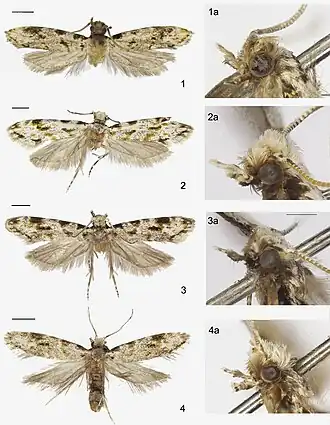
| |||||||||||||
| Taxonomische indeling | |||||||||||||
| |||||||||||||
| Geslacht | |||||||||||||
| Dryadaula Meyrick, 1893 | |||||||||||||
| Typesoort | |||||||||||||
| Dryadaula glycinopa Meyrick, 1893[1] | |||||||||||||
| Synoniemen | |||||||||||||
| |||||||||||||
Afbeeldingen op  Wikimedia Commons Wikimedia Commons
| |||||||||||||
Dryadaula op  Wikispecies Wikispecies
| |||||||||||||
| |||||||||||||

Dryadaula is een geslacht van vlinders van de familie Dryadaulidae. De wetenschappelijke naam van dit geslacht is voor het eerst voorgesteld door Edward Meyrick in een publicatie uit 1893.[3]
Soorten
- D. acrodisca (Meyrick, 1917)
- D. advena (Zimmerman, 1978)
- D. amentata (Meyrick, 1919)
- D. anthracorma Meyrick, 1915
- D. auriformis Yang & Li, 2021
- D. boviceps (Walsingham, 1914)
- D. brontoctypa (Meyrick, 1880)
- D. castanea Philpott, 1915
- D. catorthota (Meyrick, 1917)
- D. caucasica (Zagulajev, 1970)
- D. discatella (Walker, 1864)
- D. epischista (Meyrick, 1936)
- D. epixantha (Turner, 1923)
- D. flavostriata Yang & Li, 2021
- D. germana (Walsingham, 1914)
- D. glycinocoma (Meyrick, 1932)
- D. glycinopa Meyrick, 1893
- D. heindeli Gaedike & Scholz, 1998 - boszwammot[4]
- D. hellenica (Gaedike, 1988)
- D. hirtiglobosa Yang & Li, 2021
- D. irinae (Savenkov, 1989)
- D. isodisca (Meyrick, 1917)
- D. koreana Roh & Byun, 2020[5]
- D. marmoreipennis (Walsingham, 1897)
- D. melanorma (Meyrick, 1893)
- D. mesosticha (Turner, 1923)
- D. metrodoxa (Meyrick, 1919)
- D. minuta Gaedike, 2007
- D. multifurcata Gaedike, 2000[1]
- D. murenula (Meyrick, 1924)
- D. myrrhina Meyrick, 1905
- D. napaea Meyrick, 1905
- D. nedae Gaedike, 1983
- D. orientalis Park & Yagi, 2024[6]
- D. pactolia Meyrick, 1902
- D. panscia (Meyrick, 1917)
- D. placens (Meyrick, 1920)
- D. poecilta (Walsingham, 1914)
- D. rhombifera (Meyrick, 1917)
- D. securiformis Yang & Li, 2021
- D. selenophanes (Meyrick, 1880)
- D. sublimis (Meyrick, 1917)
- D. terpsichorella (Busck, 1910)
- D. trapezoides (Meyrick, 1935)[1]
- D. tripudians (Meyrick, 1924)
- D. ussurica Gaedike, 2000[1]
- D. visaliella (Chambers, 1873)
- D. zinica (Zagulajev, 1970)
- D. zygodes (Meyrick, 1918)
- D. zygoterma (Meyrick, 1917)
Bronnen, noten en/of referenties
- (de) Lepiforum e.V. (2008-2025). Dryadaulidae Bradley, 1966. Bestimmung von Schmetterlingen und ihren Präimaginalstadien. Geraadpleegd op 31-1-2025.
- ↑ a b c d Yang L-L, Li H-H (2021). The genus Dryadaula Meyrick (Lepidoptera, Tineoidea, Dryadaulidae) in China, with descriptions of four new species and a world checklist. - ZooKeys 1074: 61-81.
- ↑ a b c d e f g h i j k De Prins J., De Prins W. & Goff R. (2011–2025).Dryadaula op Afromoths, online database of Afrotropical moth species (Lepidoptera). World Wide Web electronic publication. Geraadpleegd op 1-2-2025.
- ↑ Meyrick, E. (1893). Descriptions of Australian Microlepidoptera. XVI. Tineidae - Proceedings of the Linnean Society of New South Wales, Second Series 7(4): 477-612, pag. 559.
- ↑ Koster, J.C. (2025). boszwammot Dryadaula heindeli Gaedike & Scholz, 1998. In: Muus, T.S.T. & Corver, S.C. (eds.). Microlepidoptera.nl, atlas van de kleine vlinders in Nederland. Geraadpleegd op 1-2-2025.
- ↑ Roh SJ, Shin Y-M, Lee D-J, Byun B-K (2020). The first record of Dryadaulidae (Lepidoptera, Tineoidea) from Korea with the description of a new species, Dryadaula koreana sp. nov. - Nota Lepidopterologica 43: 221-225. DOI:10.3897/nl.43.51564
- ↑ Park J., Yagi S., Kobayashi S., Hirowatari T. (2024). A new species of the genus Dryadaula Meyrick (Lepidoptera, Dryadaulidae) from Japan, with a redescription of D. epischista (Meyrick, 1936) - ZooKeys 1217: 327-342. DOI:10.3897/zookeys.1217.122695