Dichocrocis clytusalis
| Dichocrocis clytusalis | |||||||||||||||||
|---|---|---|---|---|---|---|---|---|---|---|---|---|---|---|---|---|---|
| |||||||||||||||||
| Taxonomische indeling | |||||||||||||||||
| |||||||||||||||||
| Soort | |||||||||||||||||
| Dichocrocis clytusalis (Walker, 1859) Originele combinatie Astura clytusalis | |||||||||||||||||
| Synoniemen | |||||||||||||||||
| |||||||||||||||||
Afbeeldingen op  Wikimedia Commons Wikimedia Commons
| |||||||||||||||||
| |||||||||||||||||

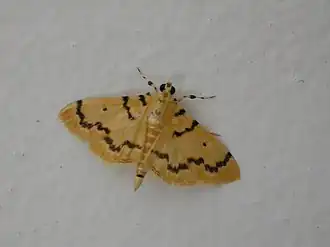
Dichocrocis clytusalis is een vlinder uit de familie van de grasmotten (Crambidae). De wetenschappelijke naam van deze soort is voor het eerst voorgesteld door Francis Walker in een publicatie uit 1859.
De spanwijdte bedraagt ongeveer 2 centimeter.[1]
Verspreiding
De soort komt in de oostelijke helft van Australië voor.[1]
Waardplanten
De rups leeft op Brachychiton rupestris, Brachychiton acerifolius, Brachychiton populneus (Sterculiaceae).[1]
Bronnen, noten en/of referenties
- (en) Nuss, M.; et al. (2003-2023). GlobIZ. Global Information System on Pyraloidea. Geraadpleegd op 30-3-2023.
- ↑ a b c Don Herbison-Evans & Stella Crossley. Dichocrocis clytusalis (Walker, 1859). Australian Caterpillars and their Butterflies and Moths. Geraadpleegd op 27-12-2024.